Citizens of Hartland were understandably concerned over the loss of one of their largest businesses with the closing of the American Woolen Company Mill. Most folks understood this wasn’t just about the people who had lost their jobs at the woolen mill but also the trickle down affects which could cripple the entire town without another major industry to support it.
*
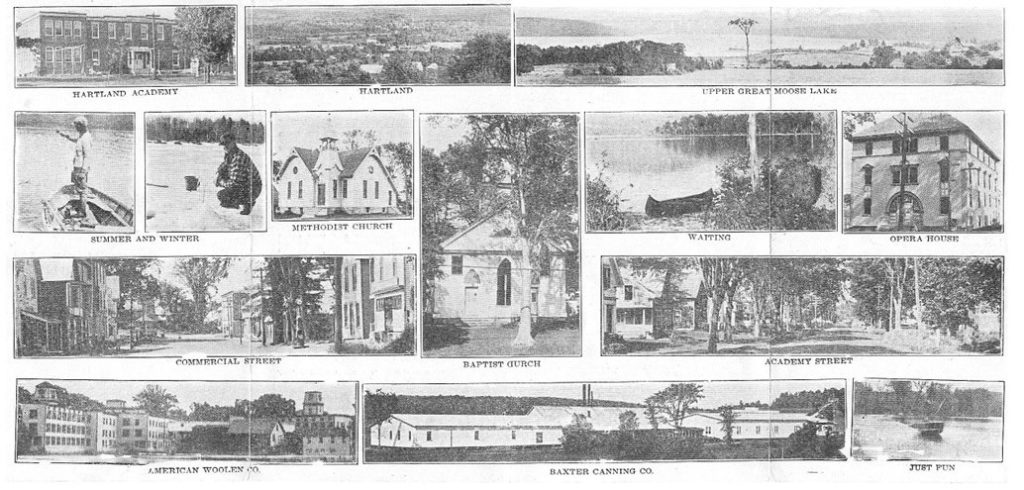
Formed in 1929, the Hartland Chamber of Commerce would later mention the search for new industry with an inclusion of current “well located vacant factory buildings” in this undated promotional brochure.
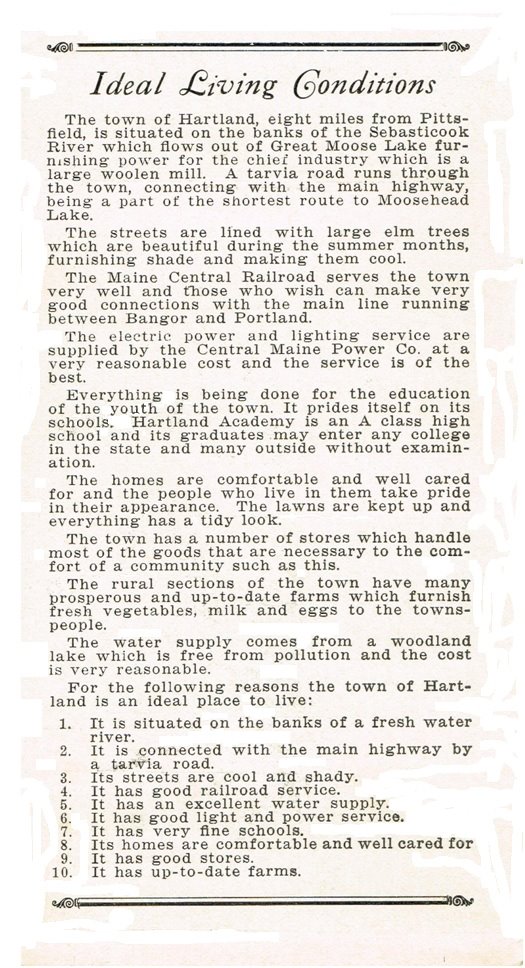
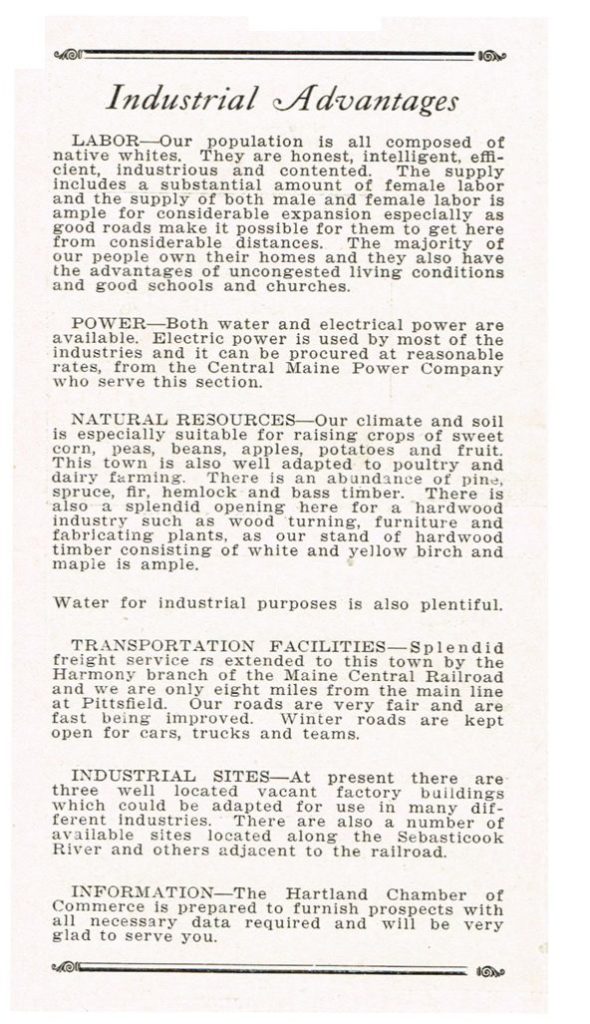
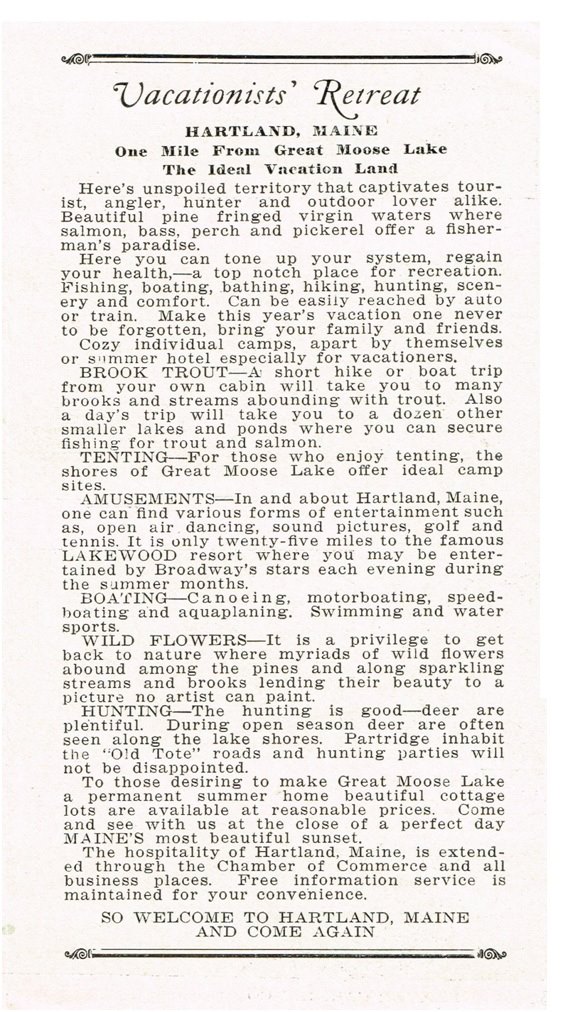
Hartland Chamber of Commerce Promotional Brochure
*
Our thanks to Hartland Historical Society Members Raymond & Beverly (Neal) Martin for their gracious donation of many of the original records of Hartland Mills, Incorporated. These detailed documents, including meeting minutes, ledgers, deeds and stock receipts, were kept by Raymond’s father Ervin W. Martin who was an early Director and also Secretary beginning in 1940 for the company for many years. Ervin organized the records into albums and kept them safe and intact for the benefit of future generations. We are still in the process of photographing the entire album and will be adding future content in the future but some of the major content highlights are presented below.
*
Most of the American Woolen Company’s non-manufacturing real estate holdings in Hartland had been sold on December 2, 1932 during the Great Auction of 1932 but the main manufacturing buildings still stood unused along with a few of its support buildings. Without an immediate replacement business available to take over the former mill buildings, citizens began to formally organize to take control of their own future and the town’s destiny.
*
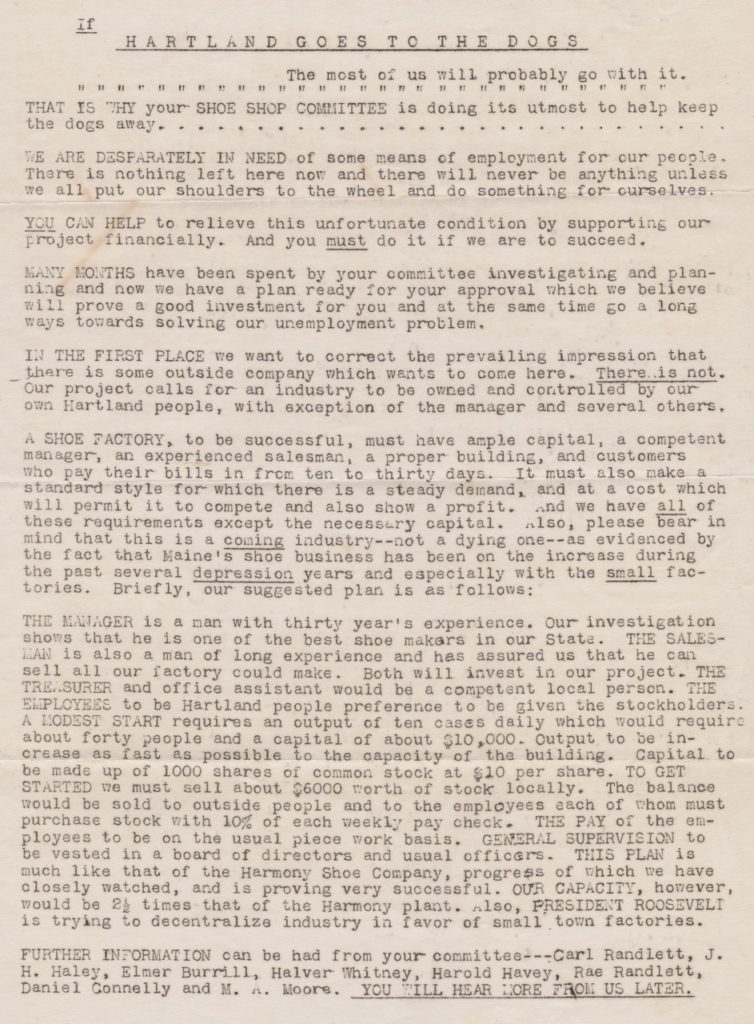
In early 1934, a citizen led group embraced a proposal by John Plummer, Superintendent of the Harmony Shoe Company, to create their own shoe shop. A Shoe Shop Committee, consisting of Carl Randlett, J. Howard Haley, Elmer Burrill, Halver Whitney, Harold Havey, Rae Randlett, Dan Connelly & Merrill Moore, suggested a $10,000 investment sold to interested citizens and businesses via common stock shares valued at $10 each. The Shoe Shop plan never came to fruition but it did not stop citizens from pursuing another option.
“If…Hartland Goes to the Dogs”
*
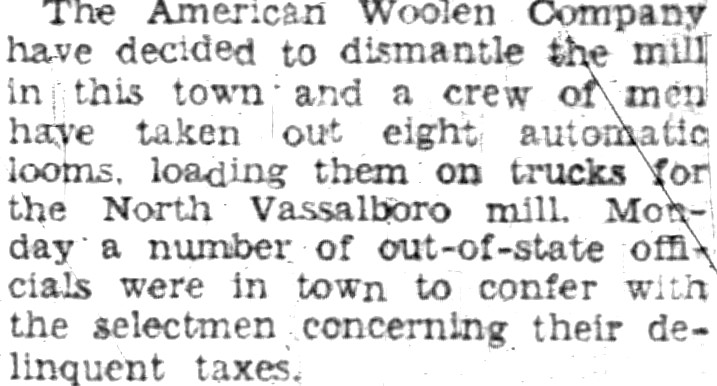
By Spring of 1934, any lingering hope of the American Woolen Company resuming operations in Hartland ended for good when they began dismantling and removing equipment from the mills.
Published June 1, 1934 – Morning Sentinel
*
A new plan of action called for the formation of a citizen led investment group to purchase the remaining mill buildings and invest in clean-up, repairs, upgrades and maintenance financed through a capitol stock plan with the ultimate goal of finding a suitable business to occupy the properties on a long term basis.
A committee, which included Elmer Burton, Rae Randlett, Frank Griffith, Lloyd Cookson and chaired by Merrill Moore, was formed to oversee the rapidly growing investment group and solicit further financial commitment to the new plan. By late 1934, the group had secured stock purchase commitments from 51 area citizens and raised enough funding to purchase the mills at public auction in Hartland on December 11, 1934.
*
“Hartland people were rejoicing today that the American Woolen Company mill, which was placed under the hammer on Tuesday (Dec. 11th), was successfully bid on by a syndicate of local men who patriotically acting on behalf of their town got together and raised $3,000, the successful bid, and retained for the town its only (mill) industry, which it is hoped can be reestablished at some future date. It was feared that if the property fell into outside hands the buildings would be torn down and any possible chance of the town having a mill industry removed for many years to come.
The local syndicate is composed of citizens and includes a few from Palmyra and St. Albans. The committee was composed of Merrill Moore, Elmer Burton, Rae Randlett, Clyde Cookson and Frank Griffith who canvassed the town and raised a sufficiently large fund to make the successful bid on the property. An effort will now be made to get a tenant for the mill.” ~ Published December 12, 1934 – The Commercial
*
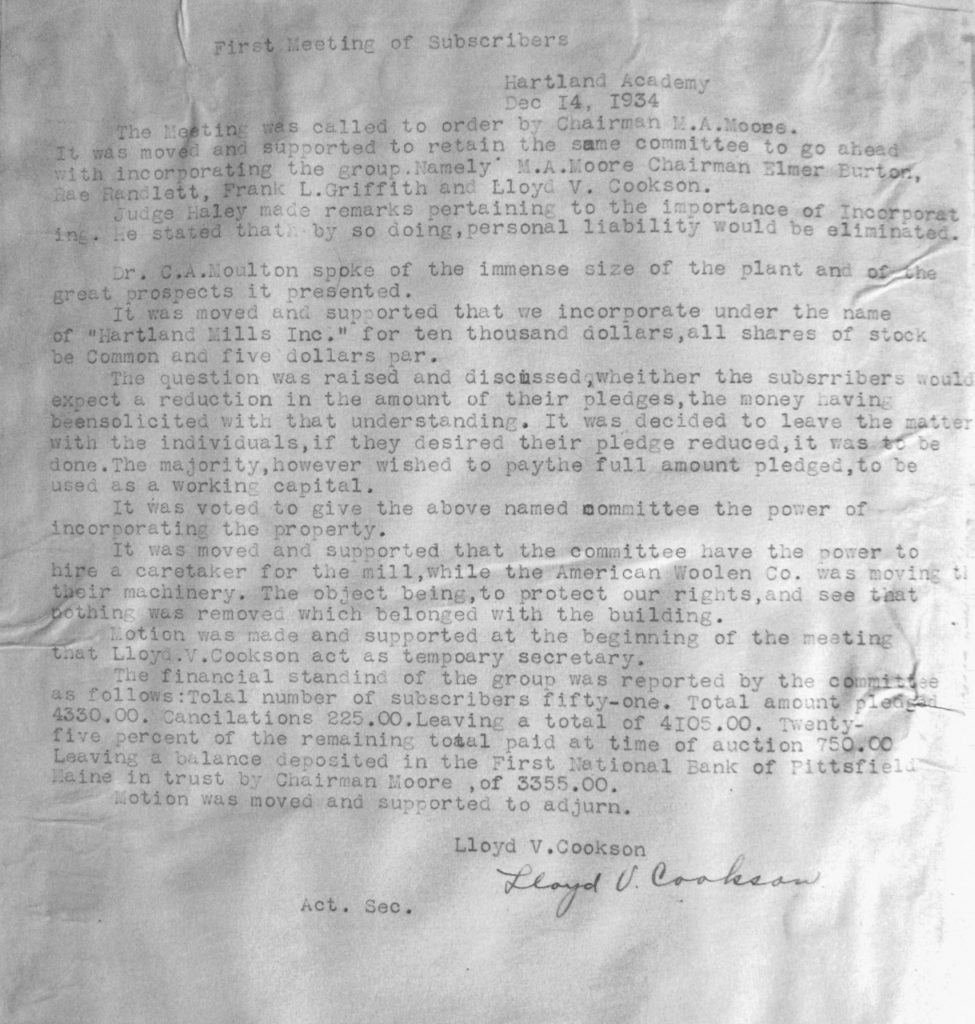
With the mill properties secured, the group held its first stock subscribers meeting on December 14, 1934 to move forward with its plans. The meeting included a vote to empower the committee to officially incorporate the group as “Hartland Mills, Incorporated” with $10,000 worth of Capitol Stock to be offered first to the stock subscribers in 2,000 units valued at $5.00 each.
1st Meeting of Subscribers of Hartland Mills, Incorporated – December 14, 1934
The committee took little time to move on their subscribers empowerment to create Articles of Association and incorporate. The signers of the original article were Merrill Moore, Rae Randlett, Frank Griffith & Lloyd Cookson as noted below.
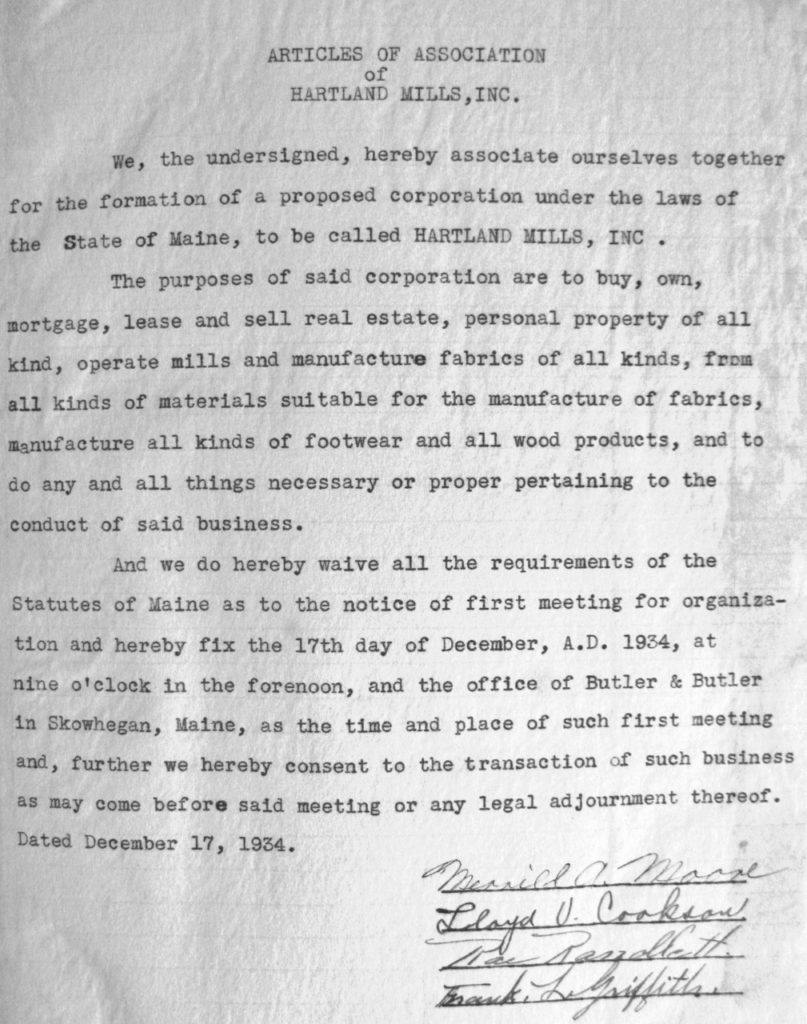
Articles of Association for Hartland Mills, Incorporated – December 17, 1934
*
On December 17, 1934, the Articles of Association for Hartland Mills, Incorporated were presented and signed at the Law Offices of Butler & Butler in Skowhegan and recorded in the Registry of Deeds on December 19, 1934. Following the signing, Merrill Moore was elected temporary Chairman and Lloyd Cookson was elected temporary Clerk until the first official meeting of stockholders could be held.
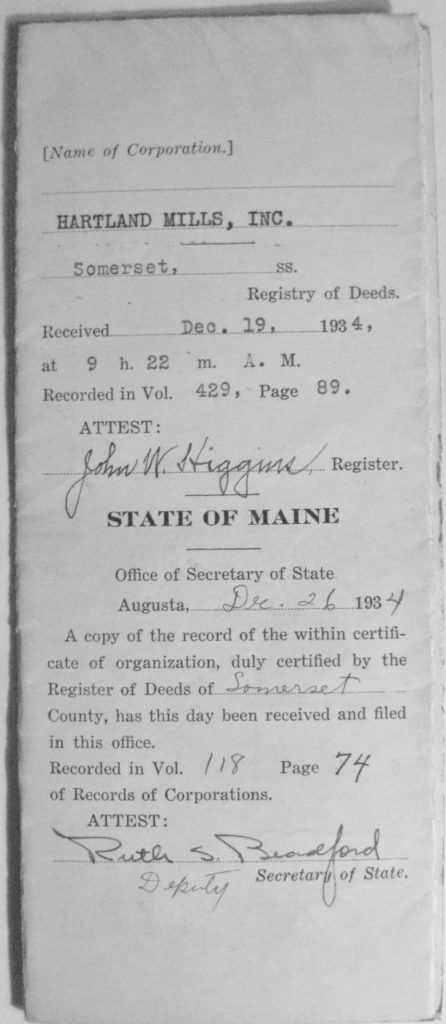
Hartland Mills, Incorporated – Registry of Deeds
*
Now officially incorporated, Hartland Mills, Inc. held its first meeting on December 28, 1934 at Hartland Academy to elect 7 Directors as required in their By-Laws. Those elected as the first Directors were Carl Randlett, Rae Randlett, Frank Griffith, Merrill Moore, Edward Latty & Alfred Bigelow. Also having been elected as Clerk, Lloyd Cookson automatically became a Director.
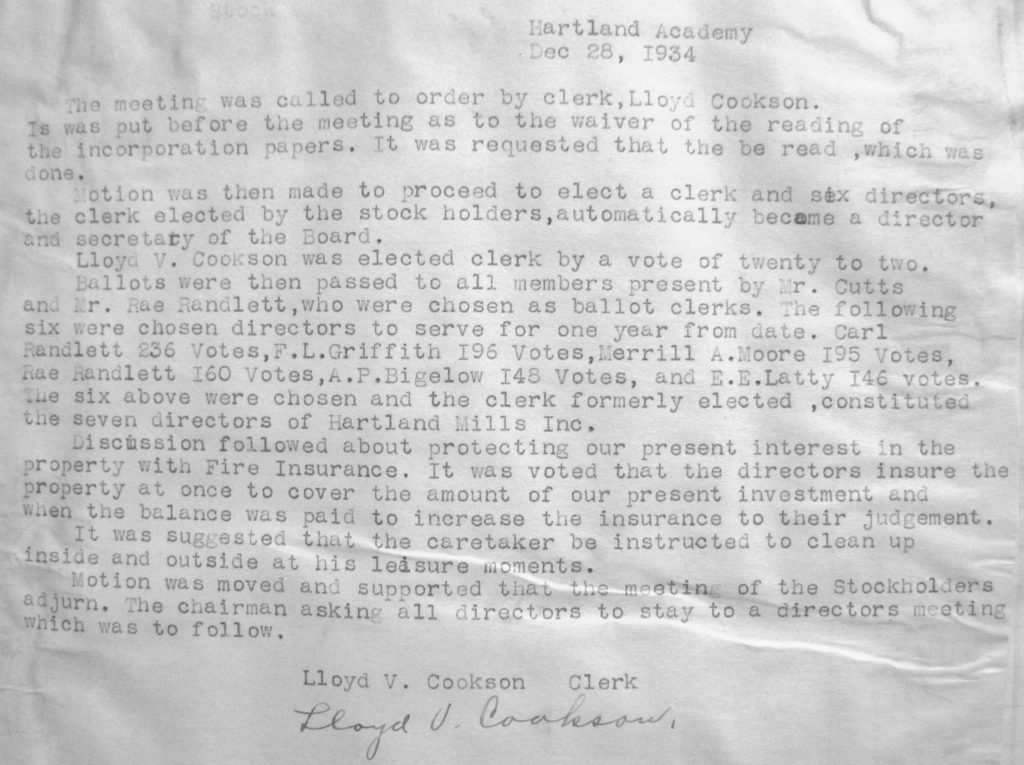
Election of Directors for Hartland Mills, Inc. – December 28, 1934
*
Immediately following the election of Directors, the first Officers were also elected:
Merrill A. Moore, President | Carl F. Randlett, Treasurer | Lloyd V. Cookson, Clerk | Edward E. Latty, Auditor
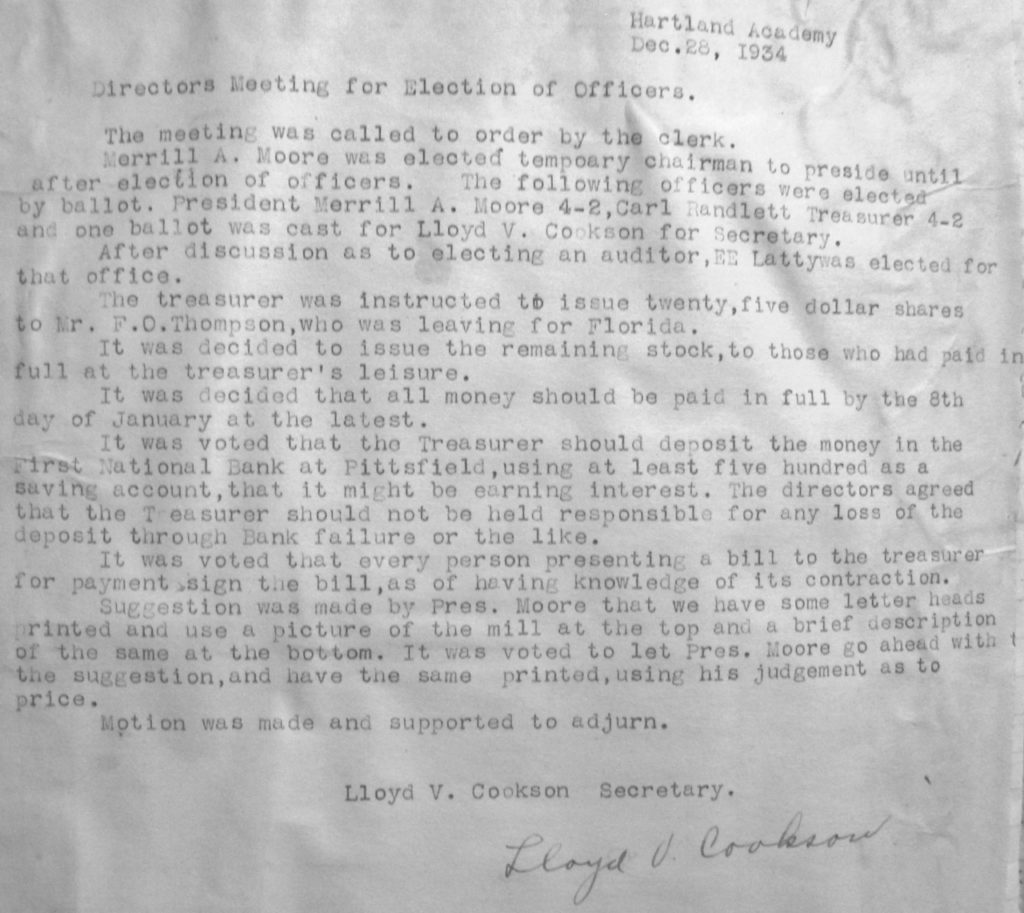
Election of Officers for Hartland Mills, Inc. – December 28, 1934
*
One of the first orders of business for the newly created company was to collect funds and issue stocks from their pledged subscribers. On January 2, 1935, the first official stock certificate of Hartland Mills, Inc. was issued to Frank O. Thompson for 20 shares ($100.00). As noted in the December 28, 1934 Directors Meeting above, Mr. Thompson was leaving for Florida for the winter and the stock was post-dated for him.
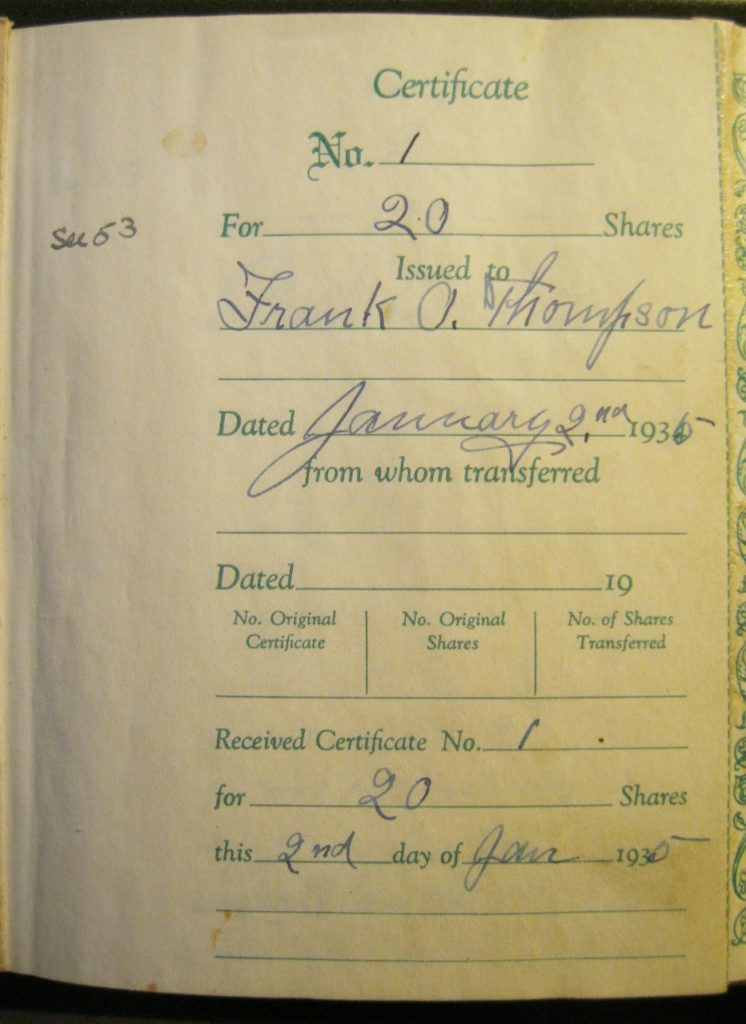
Hartland Mills, Inc. – Receipt for 1st Share Sold – January 2, 1935
*
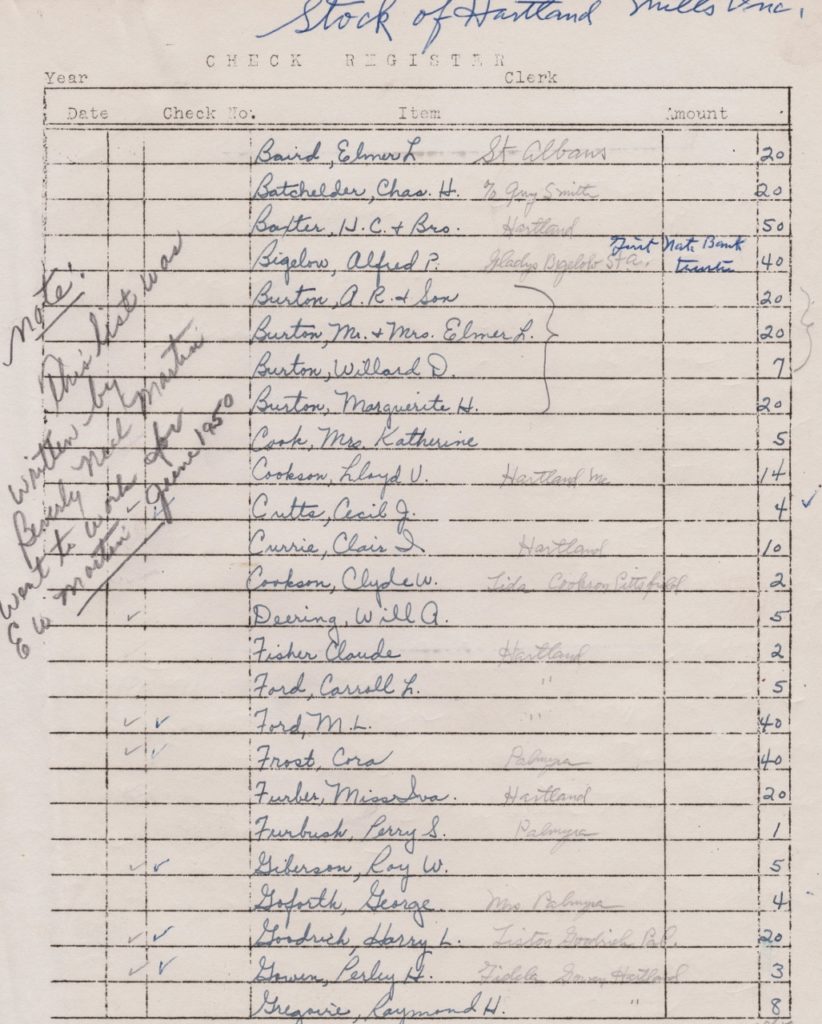
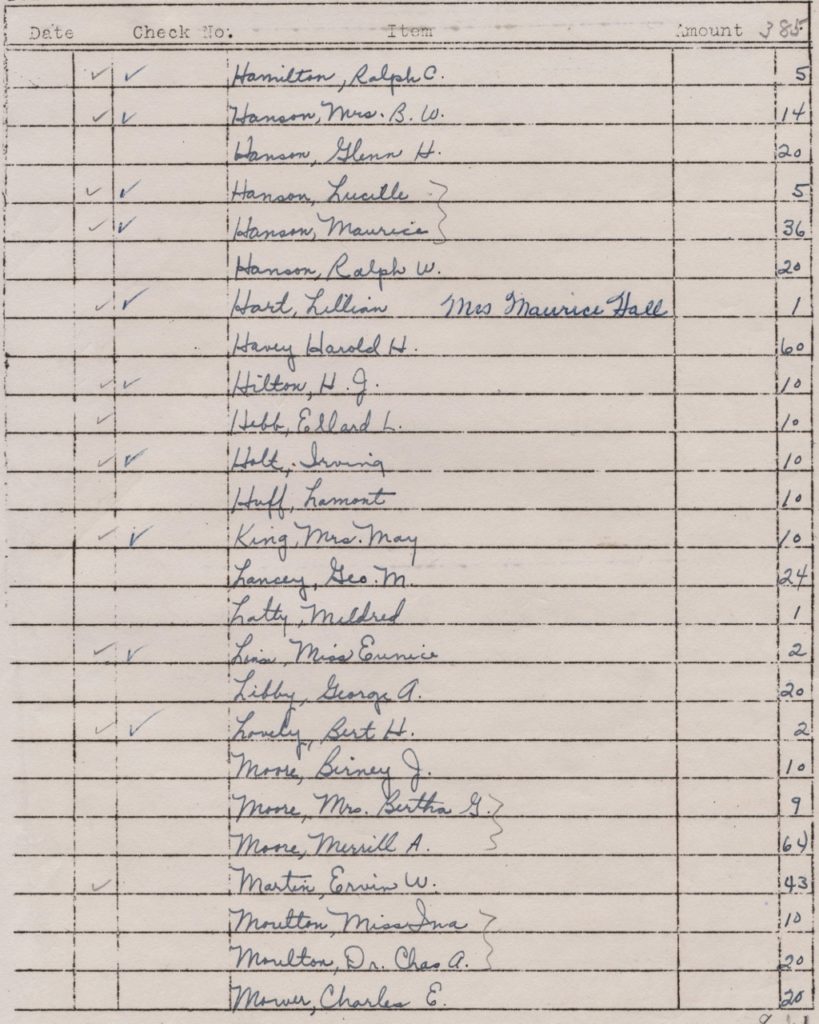
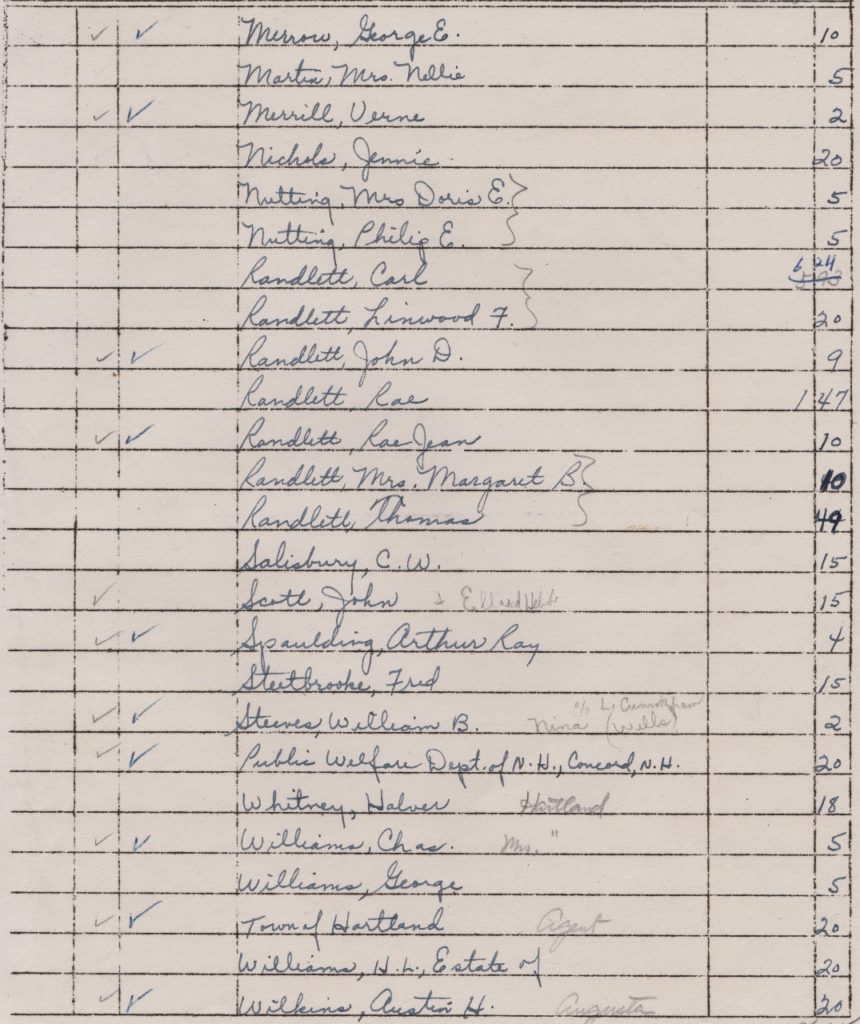
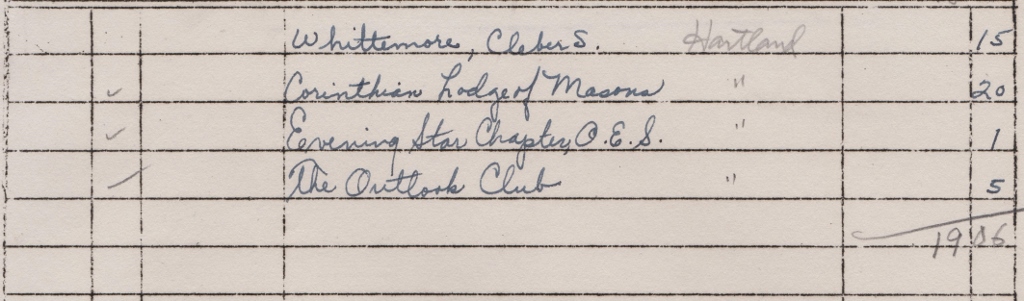
The stock certificates given to the stock holder were numbered, signed and officially sealed by Treasurer Carl Randlett. Stock purchases (and later stock transfers) were made by numerous Hartland citizens, businesses and civic organizations over the years of the existence of Hartland Mills, Inc. eventually totaling 1,906 shares. The original stock book contains each of the stock holder transactions in order of sale however much of the original stock purchased was sold or transferred for various reasons over the years.
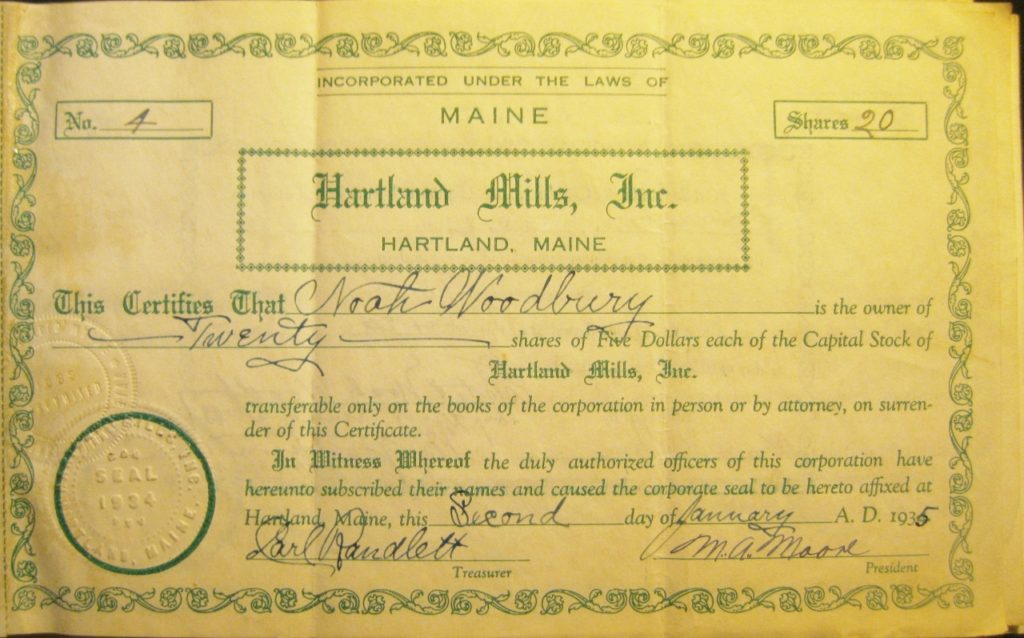
Hartland Mills, Inc. – Noah Woodbury Stock Holder Certificate
*
The goals of Hartland Mills, Inc. were to keep the mill facility physically intact, make needed repairs and find a suitable buyer to take it over. They needed to get the mill and its grounds back in top condition for potential investors. Many former woolen mill employees and numerous townspeople provided their time for minimal or no pay to assist in cleaning, repairing and preparing the mill for sale.
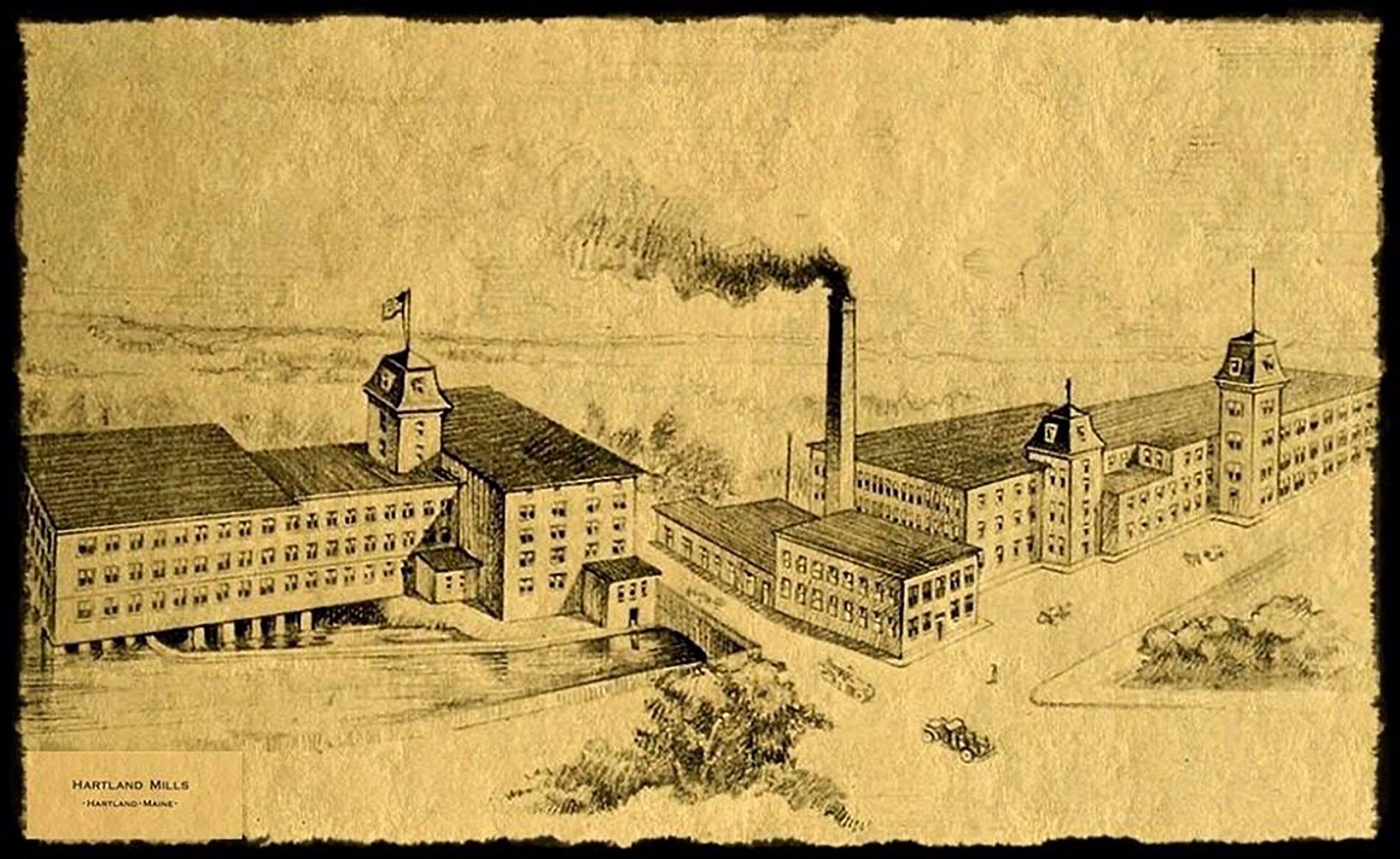
Hartland Mills, Inc. Advertisement with Artist Rendering of the Mills – 1935
*
The advertisement below appeared throughout various publications nationwide noting the great potential of operating a business in Hartland.
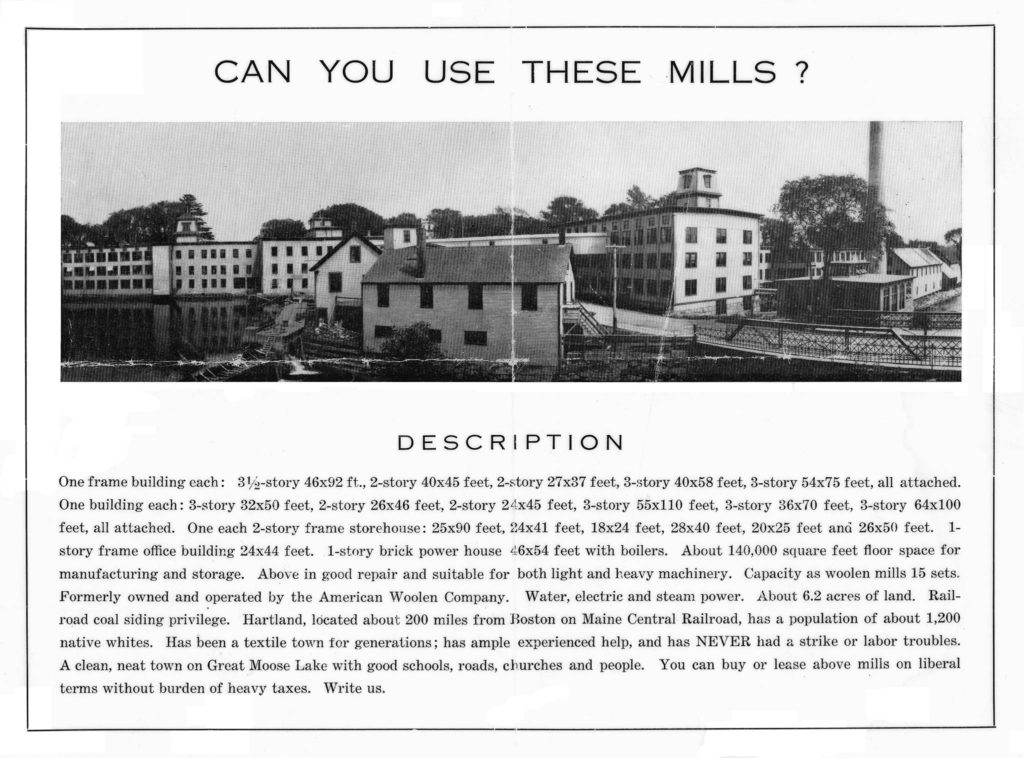
Hartland Mills, Inc. Advertisement with Building Details & Descriptions – 1935
*
Throughout 1935, there were several offers made to lease or buy the mills including one offer to start a ladies garment company. None of the offers were accepted by the Hartland Mills, Inc. with Directors siting unfavorable lease conditions or various other unacceptable terms requested by the potential buyers. In the meantime, monthly meetings were held and work continued on various projects at the mill including removing debris, repairing broken windows and fixing leaks in the roof.
*
There were also discussions on the sale of some of the other buildings now controlled by Hartland Mills, Inc. including the former Blacksmith Shop on the Island to be sold to the town to be used as a Fire Hall. This sale would not be completed however a future deal for another property at the former Carding Mill on Hubbard Avenue would be made in 1940 just before the Hartland Volunteer Fire Department reorganized in 1941.
*
Another of the woolen mill properties was the former Main Office building on Commercial Street built for the Linn Woolen Mill in 1862. In May of 1935, Trustees of the Hartland Public Library were denied a proposal to purchase or lease the building although the Directors did offer them the former Robert E. Latty Block vacant lot next to the Drug Store on Main Street should they desire to build a new building.
Although their earlier attempt in May to procure the former mill office building was unsuccessful, at a special September 25, 1935 Stock Holders Meeting on the topic, Hartland Public Library Trustees Dr. Charles A. Moulton & George M. Lancey again pleaded their case in further detail. This time the proposal was accepted by a substantial majority of the stock holder shares. (Each share equaled one vote)
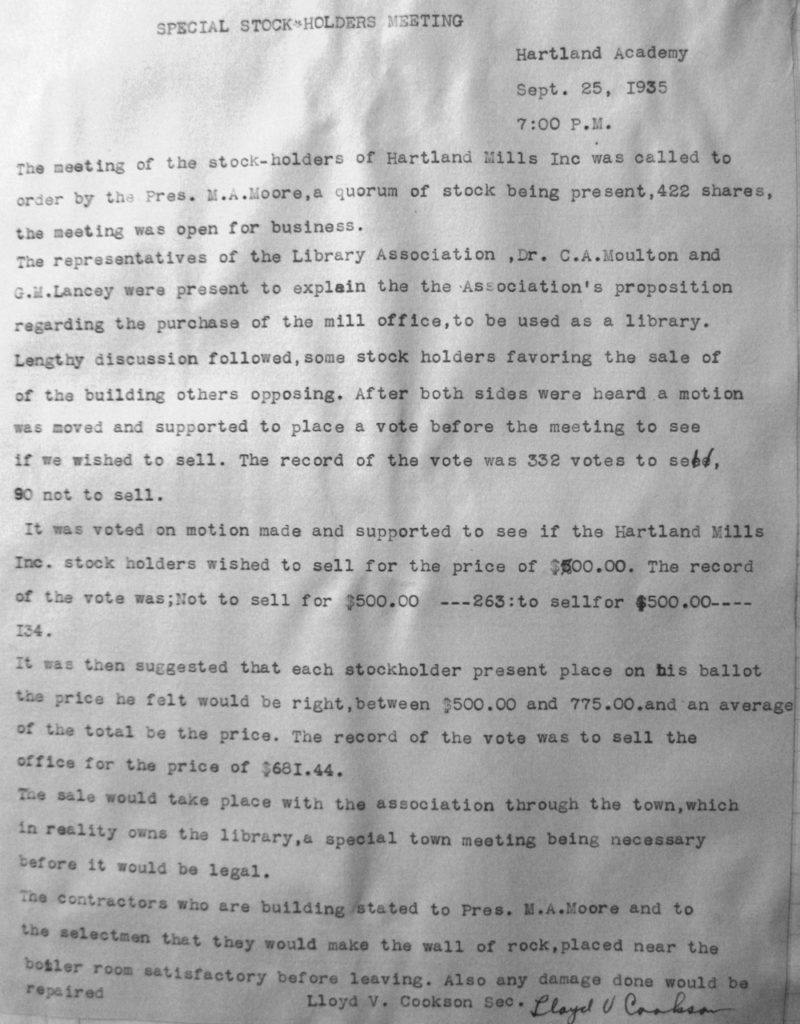
Hartland Library Special Share Holders Meeting – September 25, 1935
*
Following a special Town Meeting to formally vote on the proposed sale, it became the first dedicated home of the Hartland Public Library.
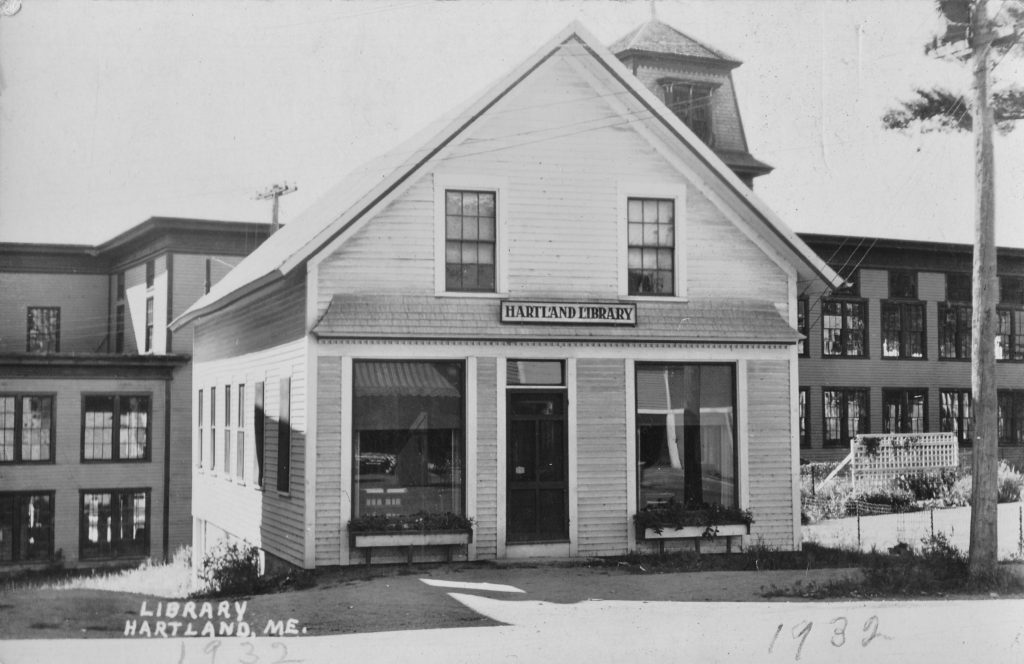
The new dedicated home of the Hartland Public Library on Commercial Street – 1935
*
In April of 1935, a letter to Hartland Mills, Inc. from George Wallace, owner of the Ohio Carpet Company based out of West Warren, Massachusetts, stated he had a firm interest in locating a business at the mills pending the process of a loan he was confident would be approved. His company specialized in automobile carpeting and held a long term contract with General Motors. His factory in Massachusetts had been badly damaged by a March flood followed by a fire which destroyed the remainder of the building forcing him to look for a new location for his business. Negotiations between the two parties began at once and included an offer of a 10 year lease with a final buyout of $14,000 along with 10 years of (potential) tax abatement and a “spirit of cooperation in every way”.
An engineer from the carpet company was sent to Hartland to survey the site on April 18th and a contract was signed with Ohio Carpet Company President George Wallace in June to establish a new carpet manufacturing operation in the former woolen mill. In order to complete the remaining needed repairs on the various buildings, Hartland Mills, Inc. voted to take out a $15,000 loan via the Reconstruction Finance Corporation (RFC). Plans by the Ohio Carpet Company to begin shipping equipment were in place by September and it appeared Hartland was going to have a major industry again, but…
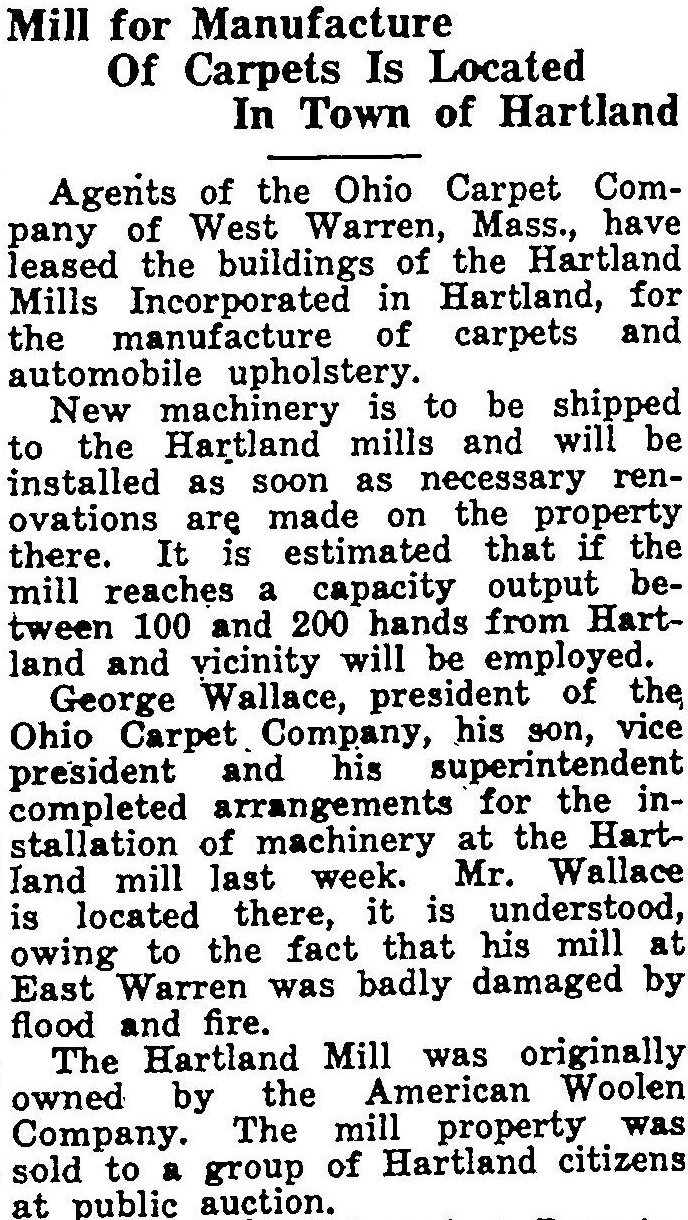
Pittsfield Advertiser – May 28, 1935
*
Unfortunately at a Directors Meeting of Hartland Mills, Inc. on November 27th, they were informed the Ohio Carpet Company had backed out of the deal siting an inability to raise sufficient capitol after their loan application was rejected by their bank. Undoubtedly frustrated, the group remained completely focused on the goal and they set their sights on finding another potential investor.
*
On December 14, 1935, the Directors were informed of a request from Irving Tanning Company of Peabody, Massachusetts to meet with the group and tour the mill with an interest in establishing a new subsidiary for their company. Hartland’s future was about to change once again.
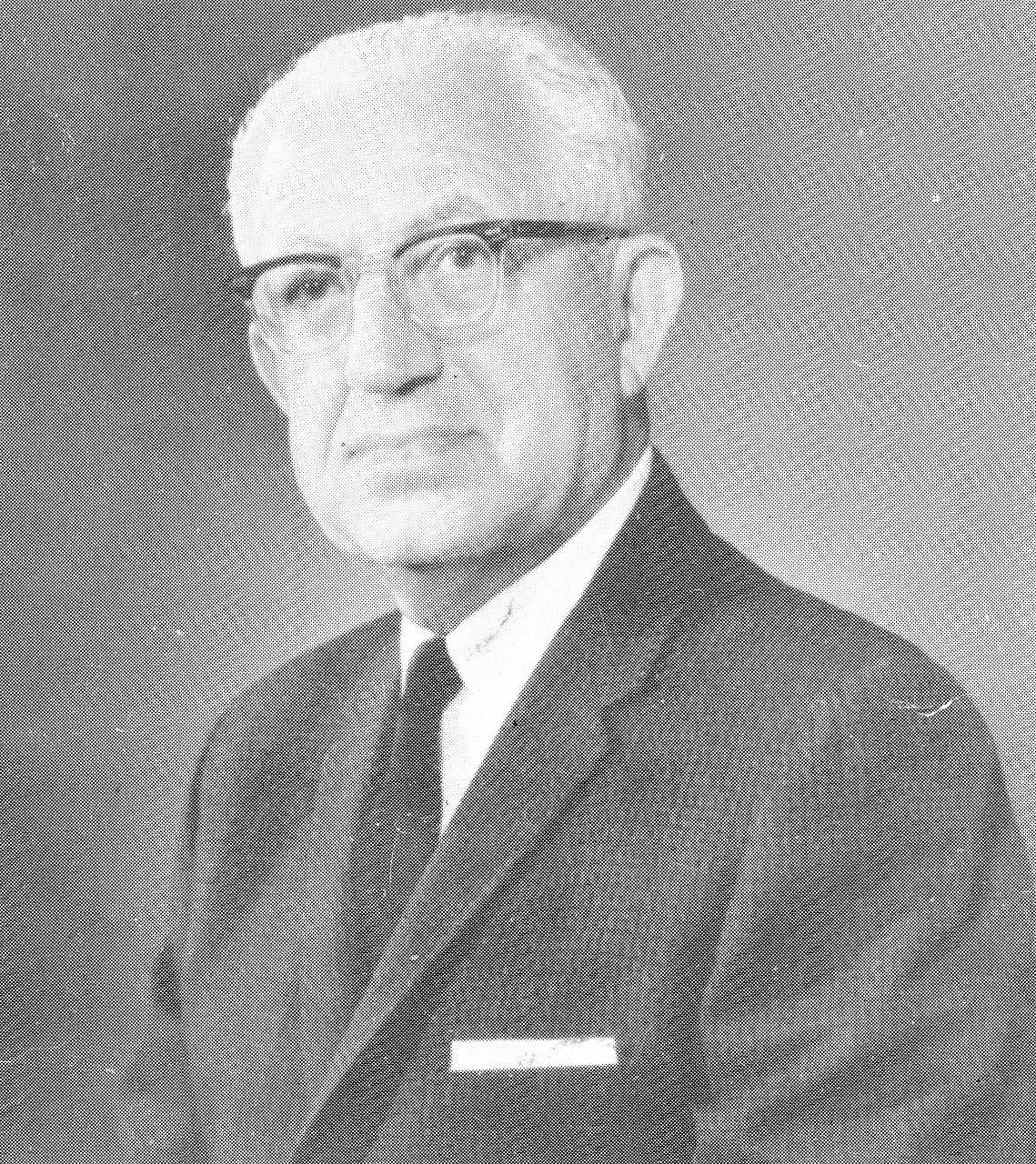
Meyer Kirstein – Irving Tanning Company
*
Although the Hartland Tanning Company successfully began operations in 1936, Hartland Mills, Inc. had leased the facility and still owned all the property & buildings. The lease contract included numerous improvement projects which needed to be completed by Hartland Mills, Inc. including installation of a generator with a water wheel at the dam to power it, installation of a sprinkler system as well as the disposal of several of the smaller buildings which sat on the island. Numerous other improvements included removing left over woolen machinery, repairing all the broken windows and repairs on the roof. Now that a new business had been secured and income was being received from the lease, they could also begin paying dividends to their stock holders and by 1955 they sold their remaining interest to Meyer Kirstein and dissolved the group.
*
In June of 1950, an alphabetical listing along with the then current stock share owners and quantities was compiled by Beverly Neal (soon to be Mrs. Raymond Martin) who had just begun working in the office of Ervin W. Martin’s logging operations located on Commercial Street.